On this page
A bed designed for care at home
Hospital-bed features vary. Compare positioning controls, included accessories and the exact item prescribed with your supplier.
Compare fixed-height, variable-height and electric beds
| Type | Key distinction | Next check |
|---|---|---|
| Fixed height | Bed height is fixed | Applicable coverage criteria |
| Variable height | Bed height can change | Why height adjustment is needed |
| Semi-electric | Powered head and leg positioning; manual height adjustment | E0260 reference |
| Total electric | Powered positioning and height adjustment | CMS treats powered height adjustment as a convenience feature; total-electric beds are not covered under this policy |
These are equipment distinctions, not an eligibility test. See the CMS policy for the exact covered configurations.
Manual vs semi-electric hospital bed: compare the controls
Compare each adjustment separately. A description such as “manual” or “electric” is less useful than a written list of the controls. Ask how the head section, foot section and overall bed height are adjusted, then record the answer for each offer.
The existing semi-electric comparison above separates powered head and leg positioning from manual height adjustment. Fixed height describes the height characteristic; it should not be used as shorthand for the control method of every other adjustment. An unanswered field remains a question for the supplier.
Use the hospital-bed quote worksheet to keep the equipment description beside the payment assumptions. Your treating provider and supplier must address the features needed for your care; this comparison does not recommend a configuration.
Semi-electric vs full-electric hospital bed: ask about height adjustment
The key comparison is whether overall bed-height adjustment is powered. “Full electric” is commonly used for the total-electric category. CMS LCD L33820 distinguishes semi-electric beds from total-electric beds and excludes total-electric beds under that policy because powered height adjustment is a convenience feature.
Do not read “electric hospital bed” as a complete description or a coverage answer. Ask the supplier to reconcile its exact proposed configuration with the applicable policy and written estimate. Keep an unanswered coverage question open rather than assuming that a motor, remote control or product name establishes payment.
| Field | Answer to request | Where to record it |
|---|---|---|
| Head and foot controls | Which adjustments are powered? | Equipment description |
| Overall bed height | Is height fixed, manually adjusted or powered? | Equipment description |
| Quoted amount | What period and included items does it cover? | Written estimate |
| Payment explanation | What is covered, optional or still unresolved? | Supplier response, separate from the feature list |
Fixed-height vs variable-height hospital bed: separate height from positioning
Ask whether the whole bed's height changes, then ask how it changes. A head section that moves does not answer the question about overall bed height. Write down these two fields separately when reading a brochure, order or delivery description.
CMS treats variable-height and semi-electric beds as distinct policy categories with additional requirements. Use the coverage checks and official LCD reference for that separate review. A feature comparison cannot establish that an individual meets those requirements.
When descriptions disagree, send the same short question to each supplier: “Does this offer change the height of the whole bed, and which control changes it?” Record the reply instead of filling a missing field from a product photo.
What should I clarify about a bariatric or heavy-duty hospital bed?
Request the exact category and supplied configuration. The CMS policy distinguishes heavy-duty extra-wide and extra heavy-duty beds. Do not treat the word “bariatric” as a complete category description, a motor specification or proof of coverage.
Ask the supplier to identify the equipment it proposes, document the relevant specifications through its established process, and explain which policy category it is evaluating. This page does not select a model, determine fit or provide a handling plan. Keep patient measurements and clinical information with the provider or supplier through their established channels.
Compare the mattress and rails as separate written fields too. For the narrower question about a mattress in two semi-electric code descriptions, see the E0260 versus E0261 comparison; do not extend that comparison to every bed category.
Worked example: two “electric bed” quotes with different details
Illustrative administrative example: Offer A says “semi-electric bed with mattress”; Offer B says “electric bed” and gives one total. No price, patient or actual supplier is represented.
- Resolve the type. Ask B which adjustments are powered and how overall height changes. Do not assume that the two labels describe the same configuration.
- Resolve included items. Ask both suppliers to list the mattress and rails. A blank field is an open question, not confirmation that the item is included or omitted.
- Resolve the period. Compare the rental or purchase arrangement and the period attached to each amount before comparing totals.
- Close the record. Keep the revised written descriptions beside the original offers, mark the clarified fields and leave unanswered questions with a named follow-up contact.
Continue with the order, quote and receipt comparison, pre-delivery equipment questions and fee-versus-bill explanation. These steps organize the conversation; they do not approve the order or calculate a personal bill.
Editorial comparison prepared October 23, 2026. Official sources checked for this supplement: CMS Hospital Beds and Accessories, L33820 and Medicare hospital-bed coverage. Existing named source reviews retain their own dates.
Before arranging a bed
- Discuss the need with your treating provider.
Ask which positioning features are necessary for your care.
- Confirm the supplied configuration.
Ask whether the mattress and rails are included and which code the supplier plans to bill.
- Get a written cost explanation.
Ask about rental terms, assignment and any upgrade charges before delivery.
Looking for Medicare eligibility?
The coverage guide separates general Part B rules from equipment-specific policy.
Read the hospital-bed coverage guideGet a usable equipment description
Before comparing two offers, ask each supplier to describe the adjustment controls, mattress, rails and proposed billing code in writing. Use the same fields for both offers; leave an unanswered field unresolved.
Question to take away: “Which adjustments are powered, how is the height adjusted, and which mattress and rails are included in this quote?” This is a comparison prompt, not a recommendation for a particular bed.
Record the answers in the quote worksheet · Clarify the proposed equipment before delivery
Equipment illustration
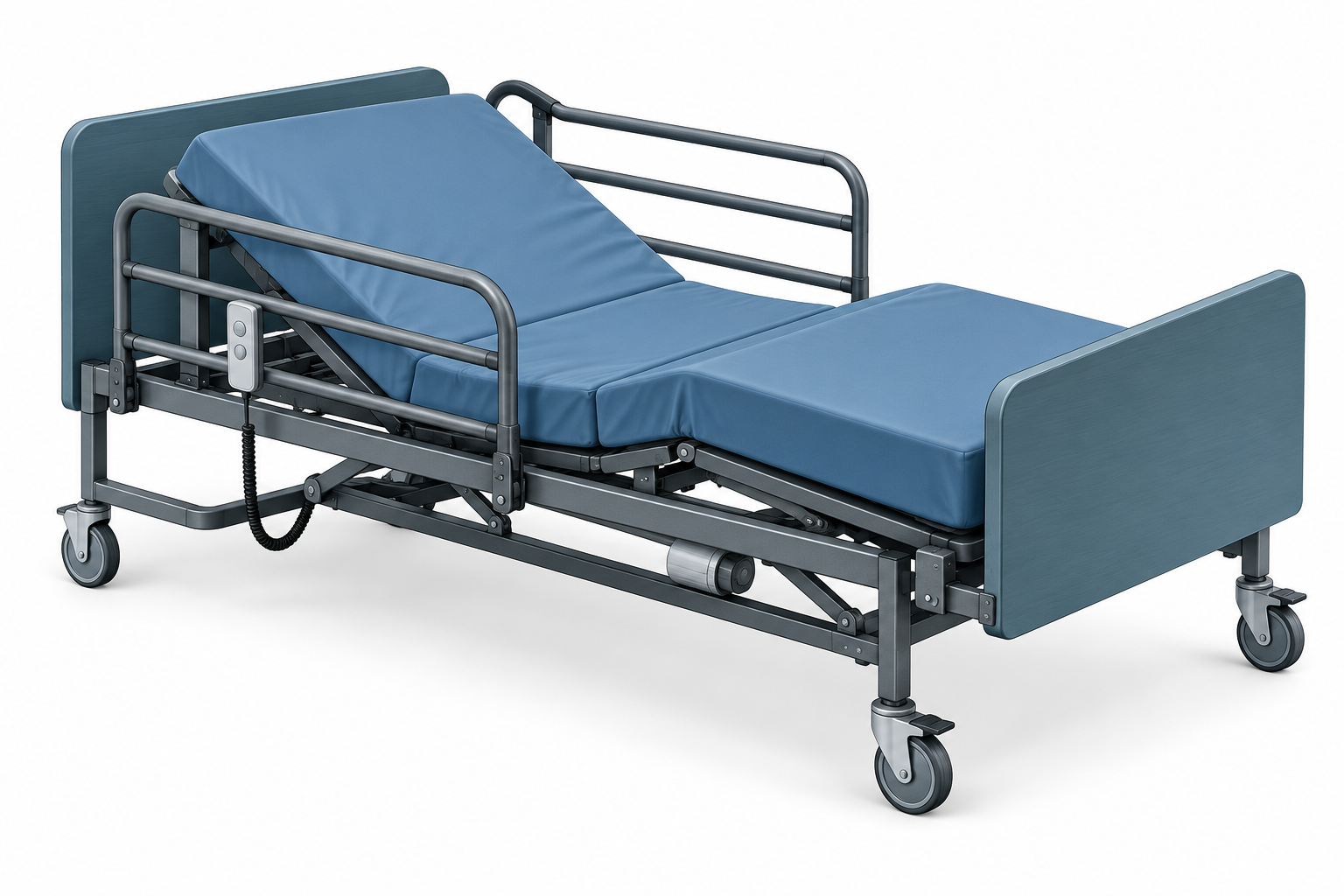 AI-generated equipment illustration · Not a verified product model or safety setup
The raised mattress section is at the head of the bed. The footboard is opposite it, and the side rails run alongside the mattress.
Comparison prompts and reading order updated October 18, 2026. The source snapshots and named reviews below retain their recorded dates.
Applicable jurisdiction
NCD 280.7 provides the national coverage layer. L33820, A52508 and A55426 list the following DME MAC contracts and state/territory scopes. This reference summarizes Original Medicare; Medicare Advantage plan requirements need separate confirmation.
J-A · Noridian Healthcare Solutions, LLC · Contract 16013
CT, DE, DC, ME, MD, MA, NH, NJ, NY, PA, RI, VT
J-B · CGS Administrators, LLC · Contract 17013
IL, IN, KY, MI, MN, OH, WI
J-C · CGS Administrators, LLC · Contract 18003
AL, AR, CO, FL, GA, LA, MS, NM, NC, OK, PR, SC, TN, TX, VI, VA, WV
J-D · Noridian Healthcare Solutions, LLC · Contract 19003
AK, AS, AZ, CA, GU, HI, ID, IA, KS, MO, MT, NE, NV, ND, MP, OR, SD, UT, WA, WY
DME MAC policy jurisdiction is separate from fee-schedule Former CBA and rural ZIP geography. The fee lookup does not select or approve a coverage policy.
Order and documentation context
- A55426 requires a standard written order (SWO) before a claim is submitted, supporting medical records, and supplier proof-of-delivery records. Item-specific LCD and policy-article requirements must also be checked.
- Face-to-face encounter and written-order-prior-to-delivery (WOPD) rules apply to selected items on the applicable required list; they are not a blanket requirement for all hospital-bed codes.
- The CMS E0260 status page, observed September 30, 2026, says “No” for prior authorization and F2F/WOPD. This observation is not a historical determination and does not waive SWO or coverage requirements.
- NCD 280.7 section D adds the ability to operate powered controls, with specified exceptions, to the frequent/immediate-positioning context. Read the full NCD and LCD rather than using this summary as an eligibility checklist.
The currently linked CMS required-list PDF is effective October 28, 2026. It is retained as future evidence and is not applied to the July–September 2026 fee preview.
Source dates and scope
The policy sources on this page were checked on September 30, 2026. Use the version applicable to the date of service and confirm individual coverage and payment with Medicare, your plan or supplier.
Official sources
Source checks: September 29–30, 2026. This is not a policy effective date or a clinical review. Confirm the current source and applicable version before use.
General Part B eligibility and patient cost-sharing.
Equipment-specific criteria; check the version applicable to the date of service.
Definitions and coding guidance; check the applicable version.
Coverage and documentation summary, including electric-bed limitations.
Official quarterly code file; this preview imports E0260 only. The code does not establish coverage or payment.
Compare the same bed feature across three descriptions
Compare the provider's description available to you, the supplier's written proposal and the delivery description as separate records. Do not silently make the wording identical. Ask the responsible organization to explain a difference in adjustment controls, mattress or rails. The purpose is a clearer equipment description, not a clinical judgment about which bed should be prescribed.
| Feature | Document comparison | Unresolved question |
|---|---|---|
| Adjustment controls | Copy the wording from each source | Which controls does the proposed item actually have? |
| Mattress and rails | Keep included and separate items distinct | Which document lists each component? |
| Proposed code | Record the supplier's statement | Who will reconcile a configuration difference? |
Hypothetical example: a supplier's first proposal names a semi-electric bed, while a later document says only electric bed. The reader asks for the exact adjustment description rather than assuming the two statements are equivalent. Once clarified, the reader records the revised description and its date. An equipment label is not a coverage decision.
Use the quote comparison worksheet to retain unanswered fields. For the official policy, use the LCD source shortcut. This comparison aid preserves the original clinical and policy records and does not replace supplier instructions.
Editorial task aid prepared October 23, 2026. Original policy source checks and named review dates remain separate.
Choose the reference for your next hospital-bed question
This page: Equipment features and official source navigation.
- Coverage requirements — Coverage scope and questions for the provider/supplier.
- E0260 descriptor — Explain the reviewed E0260 descriptor.
- E0260 versus E0261 — Compare the reviewed code descriptions.
- E0260 fee reference — Explain Q3/Q4 amounts, units and periods.
- Supplier quote comparison — Compare offers and document revisions.
- Fee versus bill — Reconcile amount types and assumptions.